
The Ultimate Branding Guide for Businesses in Saudi Arabia is created for business owners, marketing teams, brand managers, and decision-makers who want their company to be easier to find, easier to understand, and easier to trust. In Saudi Arabia, customers are exposed to more brands than ever before. A company cannot depend only on price, location, or old relationships. It must communicate clearly across digital platforms, physical spaces, printed materials, signage, social media, events, and every customer touchpoint.
This guide explains how to approach branding as a business growth tool, not only as a marketing activity. The goal is not to create more noise. The goal is to create clarity, trust, recognition, and measurable action.
Colorcode Advertising works across strategy, creative design, production, printing, signage, media production, exhibitions, environmental branding, digital marketing, and AI-powered workflow solutions. This article connects those capabilities into one practical guide for businesses that want stronger brand visibility in the Saudi market.
Why This Matters for Businesses in Saudi Arabia
Saudi Arabia is a fast-moving market with growing competition across retail, healthcare, real estate, hospitality, entertainment, education, technology, food, events, and professional services. New brands are entering the market, existing businesses are expanding, and customers are becoming more selective. In this environment, branding must be planned with care.
Many businesses make the mistake of investing in marketing activities without building a clear foundation. They post on social media, print brochures, create videos, attend exhibitions, or install signage, but the message is not connected. The result is scattered visibility instead of strong brand memory.
A strong approach to branding helps businesses look more professional, communicate faster, build trust, and convert attention into enquiries. It also makes the sales process easier because customers already understand the company before the first meeting.
- Improves brand recognition
- Supports lead generation
- Builds trust before the sales call
- Creates consistency across online and offline touchpoints
- Makes the company easier to remember
- Helps the business compete beyond price
What Branding Really Means
Branding is not only the visible output. It is not only a design, post, video, sign, print, booth, or campaign. It is the thinking behind the output and the way that output supports a business goal.
A business should begin with a simple question: what do we want the customer to think, feel, understand, or do after seeing this? If the answer is unclear, the final output will also be unclear.
For example, if the goal is awareness, branding should be simple, memorable, and easy to recognize. If the goal is conversion, the message and call to action must be direct. If the goal is trust, the execution must feel professional and credible.
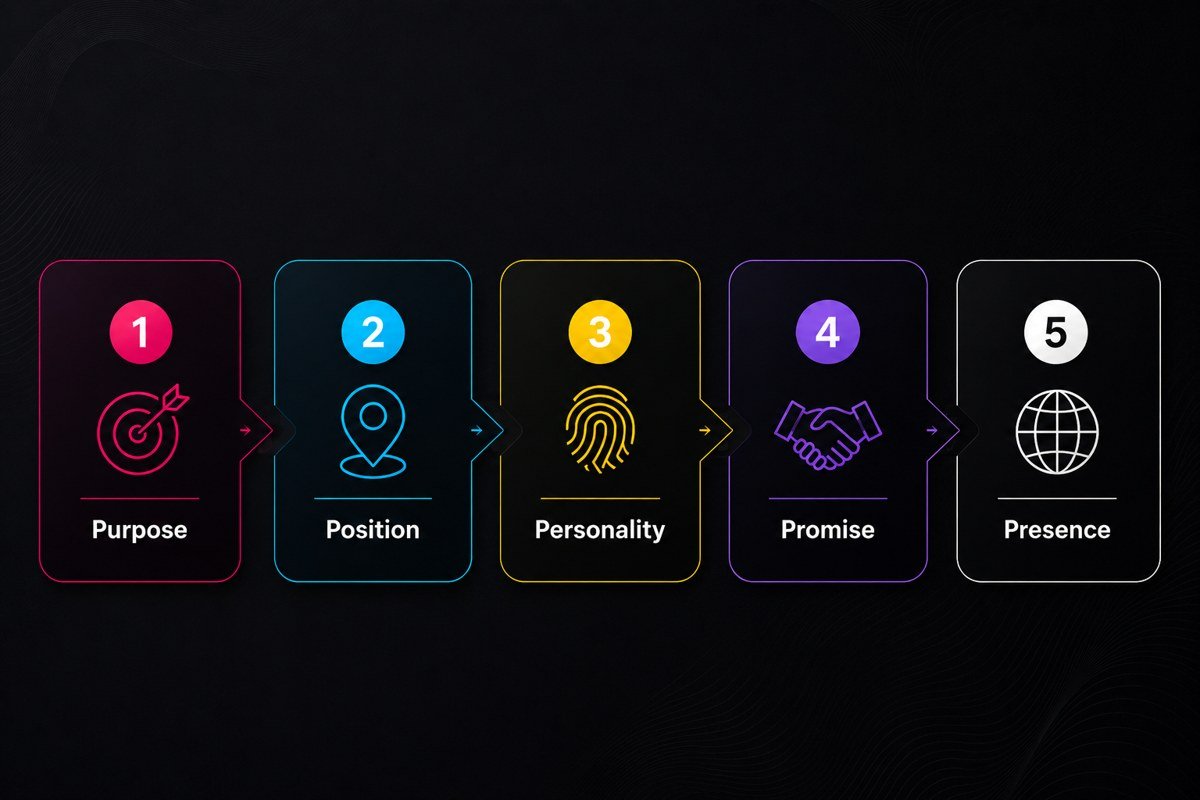
The Colorcode Brand DNA Framework
To make the process practical, Colorcode uses the The Colorcode Brand DNA Framework. This model helps businesses move from unclear ideas to structured execution.
- Purpose: This pillar ensures the project has a clear role in the customer journey and supports the business objective.
- Position: This pillar ensures the project has a clear role in the customer journey and supports the business objective.
- Personality: This pillar ensures the project has a clear role in the customer journey and supports the business objective.
- Promise: This pillar ensures the project has a clear role in the customer journey and supports the business objective.
- Presence: This pillar ensures the project has a clear role in the customer journey and supports the business objective.
The framework is useful because it prevents random decisions. Instead of choosing colors, materials, content, layouts, or platforms based only on personal taste, the team can make decisions based on the brand, audience, and expected result.
Planning Before Execution
The most expensive mistakes usually happen before execution begins. When the brief is unclear, every stage becomes slower. Designers revise more, production teams face confusion, suppliers ask more questions, and the final result may not match the business goal.
Before starting any branding project, the business should define the objective, audience, message, tone, format, timeline, budget, approval process, and success measurement. This creates alignment between management, marketing, creative, production, and sales teams.
- Define the business goal
- Identify the audience
- Write the main message
- Choose the right format
- Set the visual direction
- Prepare brand assets
- Confirm sizes and technical requirements
- Agree on approvals and deadlines
- Measure results after launch
Design and Communication Principles
Good branding must be clear before it is beautiful. Design should help people understand the message, not make the message harder to read. The best communication uses strong hierarchy, simple copy, professional visuals, and consistent brand elements.
A customer should be able to understand the main idea within seconds. This is especially important for social media, signage, exhibition booths, outdoor branding, and website hero sections where attention is limited.
Clarity
The message must be direct. Avoid long sentences, weak headlines, and too many competing elements. If everything is important, nothing becomes important.
Consistency
Colors, fonts, photography style, icons, layout, tone of voice, and brand elements should feel connected. Consistency builds recognition and recognition builds trust.
Quality
Low-quality visuals, poor printing, weak installation, or badly edited videos can damage the perception of a brand. Customers often judge business quality from communication quality.
Digital and Physical Touchpoints
In Saudi Arabia, a strong brand must work both online and offline. A customer may find the company on Google, check its Instagram or LinkedIn, visit the website, see a printed brochure, attend an event, scan a QR code, or see the brand inside a mall or office. Every touchpoint must feel connected.
This is why branding should not be isolated. Digital marketing, printing, signage, exhibitions, media production, and branding should support one another. When the same brand message appears consistently across all platforms, the company becomes easier to remember.
- Website pages
- Google search results
- LinkedIn posts
- Instagram and TikTok content
- Printed brochures
- Company profiles
- Event booths
- Indoor and outdoor signage
- Packaging
- Reception and office branding
- Sales presentations
- Email signatures
Common Mistakes to Avoid
Businesses often weaken their branding results because they rush execution or separate creative work from strategy. The following mistakes are common and should be avoided.
- Starting without a clear objective
- Copying competitors instead of defining a unique position
- Using inconsistent visuals across platforms
- Ignoring Arabic and English communication quality
- Using low-resolution images
- Designing without considering production requirements
- Not including a clear call to action
- Working with too many vendors without one direction
- Not measuring performance
- Treating branding as a one-time task
How to Measure Success
Success depends on the goal. Some branding projects are designed for awareness, while others are designed for enquiries, sales, event participation, trust, or customer education. Measurement should match the objective.
- Website visits and form submissions
- WhatsApp clicks
- Phone enquiries
- QR code scans
- Social media engagement
- LinkedIn profile visits
- Event booth leads
- Proposal response rate
- Customer feedback
- Repeat business
- Direct brand searches
Not every result appears immediately. Some activities build long-term recognition and trust. A strong brand system should measure both short-term response and long-term business value.
Practical Checklist
Before launching any branding project, use this checklist to avoid weak execution.
- Is the goal clear?
- Is the target audience defined?
- Is the message simple?
- Does the design match the brand?
- Is the Arabic copy correct?
- Is the English copy clear?
- Are the sizes and formats correct?
- Are images high quality?
- Is the call to action visible?
- Is the final output checked on mobile or in the real environment?
- Is there a plan to track results?
How Colorcode Can Help
Colorcode helps businesses plan and execute branding as part of a complete brand growth system. Instead of treating strategy, design, printing, signage, production, digital marketing, video, and exhibitions as separate tasks, Colorcode connects them under one direction.
This integrated approach helps businesses save time, reduce confusion, maintain consistency, and create a stronger impression in the market. Whether the requirement is a single campaign or a complete brand presence, the objective remains the same: create communication that is clear, professional, memorable, and useful for business growth.
Conclusion
The Ultimate Branding Guide for Businesses in Saudi Arabia is not about doing more marketing. It is about doing better marketing. Businesses that communicate clearly, execute professionally, and stay consistent are more likely to be remembered and trusted.
In a competitive market, attention is valuable. Trust is even more valuable. The companies that build both will have a stronger chance of turning visibility into enquiries and enquiries into long-term customers.
Frequently Asked Questions
What is the main benefit of branding?
The main benefit is that it helps a business communicate clearly, look professional, and build trust with customers.
Why is this important in Saudi Arabia?
The Saudi market is competitive and visually driven. Businesses need strong presentation, local understanding, and professional execution to stand out.
Can small businesses benefit from this?
Yes. Small businesses can use professional communication to compete with larger brands and build trust faster.
How often should this be reviewed?
Businesses should review major brand and marketing touchpoints every six months or whenever services, audiences, or business goals change.
How can Colorcode support?
Colorcode supports strategy, creative design, digital marketing, printing, signage, exhibitions, media production, environmental branding, and AI-powered workflow solutions.
Ready to strengthen your brand presence?
Colorcode helps businesses in Saudi Arabia move from idea to execution through strategy, creativity, production, digital marketing, signage, printing, exhibitions, and brand experience solutions.
Contact ColorcodeAbout Colorcode
Colorcode Advertising is a Saudi-based integrated advertising, creative, and production solutions company helping businesses transform ideas into memorable brand experiences through strategy, design, printing, signage, exhibitions, media production, environmental branding, digital marketing, and AI-powered workflow solutions.